Title Text

Native Iceberg Scans at Rust Speed: How DataFusion-Comet Achieves Faster Query Performance
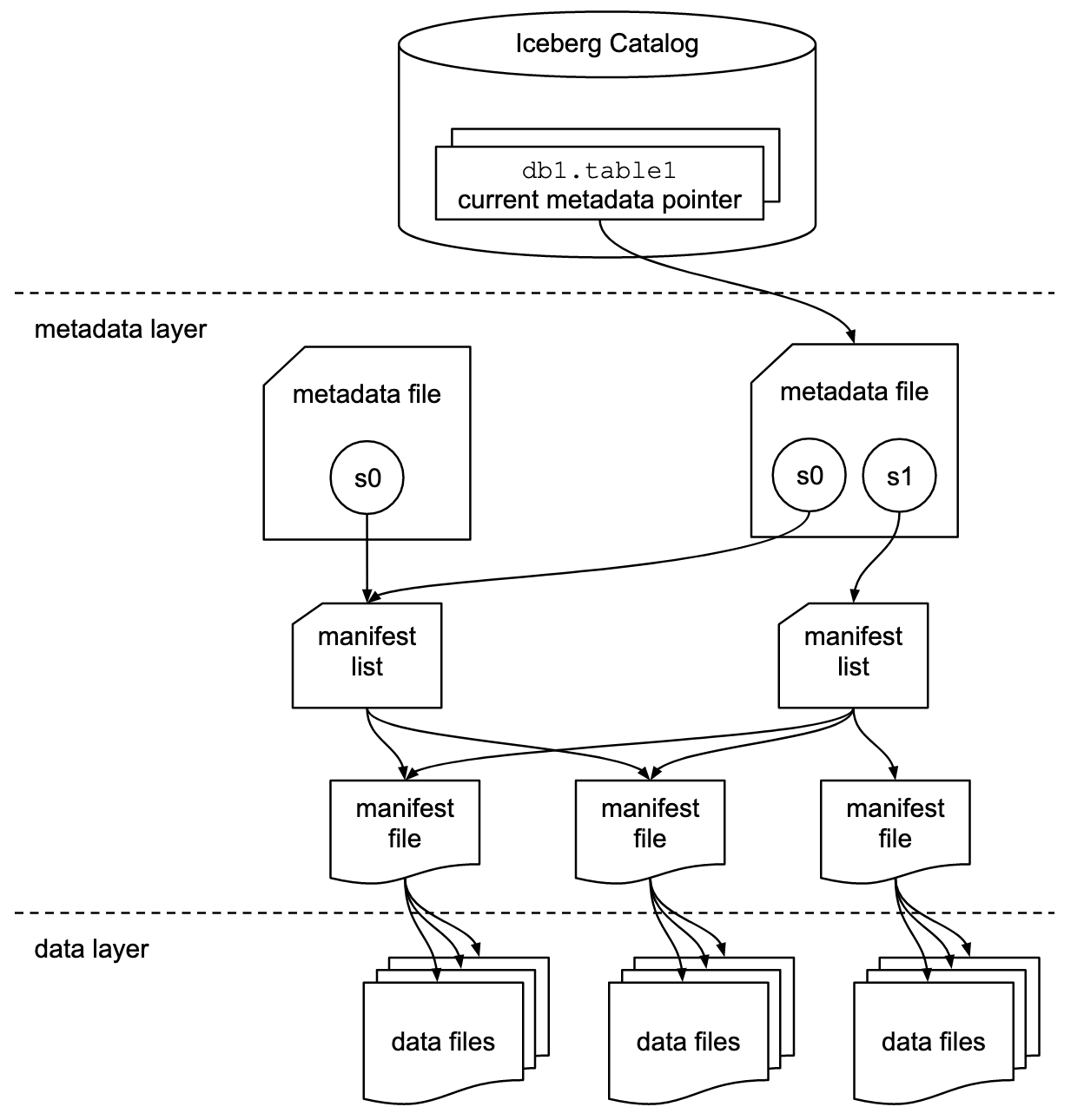
Iceberg
Ever had a query that’s logically perfect, Spark Plan looks good, but the Query still crawls ...


Kafka Queues
for Flink,Spark,KC
Datafusion-comet
Iceberg-rust
Kubeflow
GSoC Student Developer
GSoC Mentor
KIP-1289, KIP-1302, KIP-1310
Spark Iceberg Pipeline
Select Query
Insert Query
Table maintenance for Healthy table
SELECT sum(amount)
FROM iceberg.db.orders
WHERE date = '2026-03-08'
AND
amount > 1000
HashAggregateExec(sum(amount)) (Operator 3)
│
FilterExec(amount > 1000) ← post scan (Operator 2)
│
BatchScanExec(Iceberg) ← date, amount (Operator 1)
pushed: [date = '2024-01-15', amount > 1000]
Spark Physical Plan (JVM):
Aggregate [sum(amount)]
  └─ Filter [date = '2024-01-15' AND amount > 1000]
└─ Relation [iceberg.db.orders]- Operator boundaries create object churn
- JVM has to prove performance at runtime
- Row/Columnar conversions leak performance
- Parquet is decoded in JVM with heavy object overhead
Spark’s JVM Execution Model
Scans touch everything:
- Data files
- Column vectors
- Residual filters
- Row group stats
- Deletes
Spark Iceberg Pipeline
Columnar read ≠ columnar execution
Vectorization
Iceberg Parquet Table
Clarifying Native Execution

Native Execution
-
Universal Memory Format
-
Native Execution Engine
-
Native Iceberg Scan using Iceberg-rust
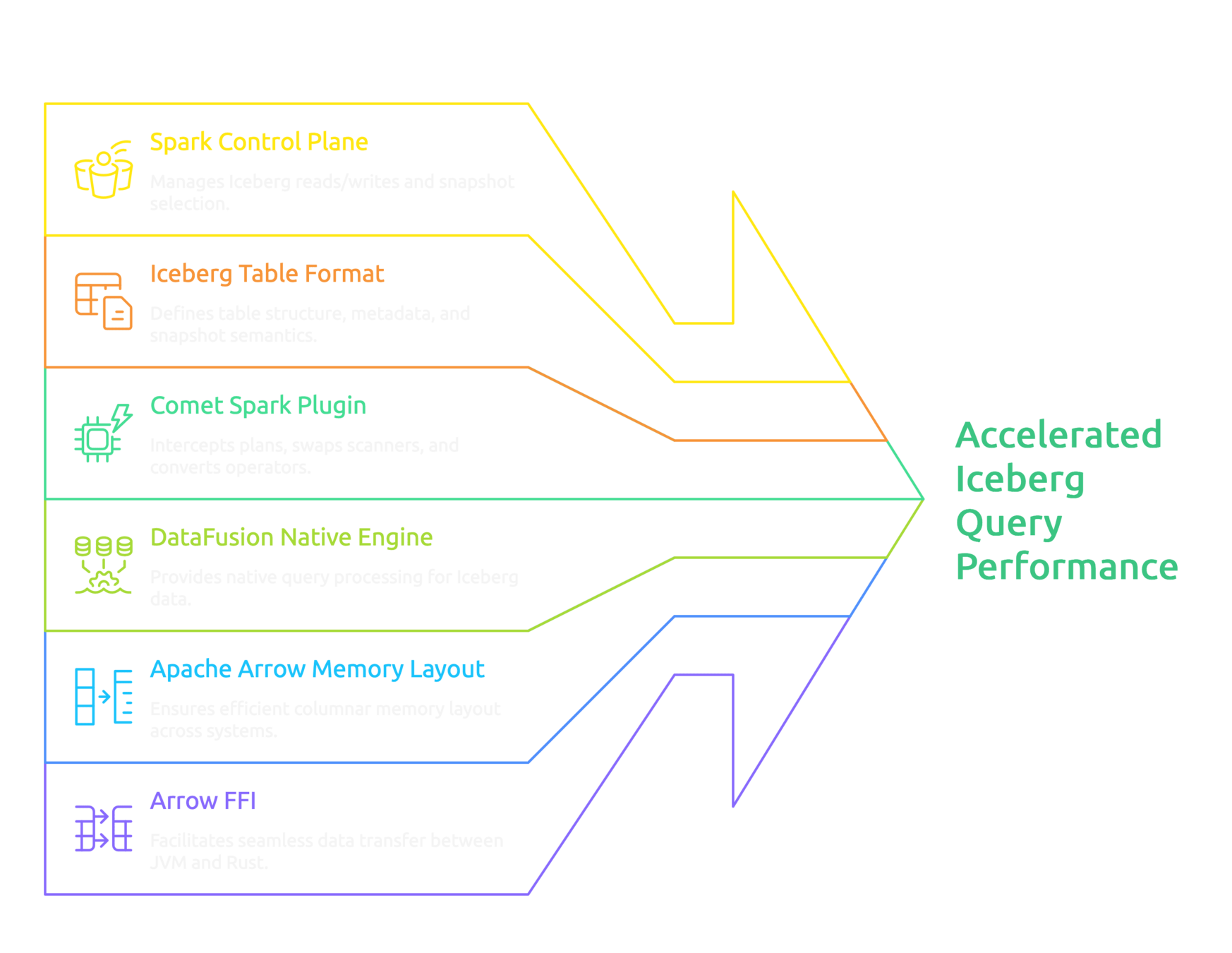
A native execution path where Arrow is the memory contract, DataFusion is the engine, and Comet is the bridge.
Native Execution
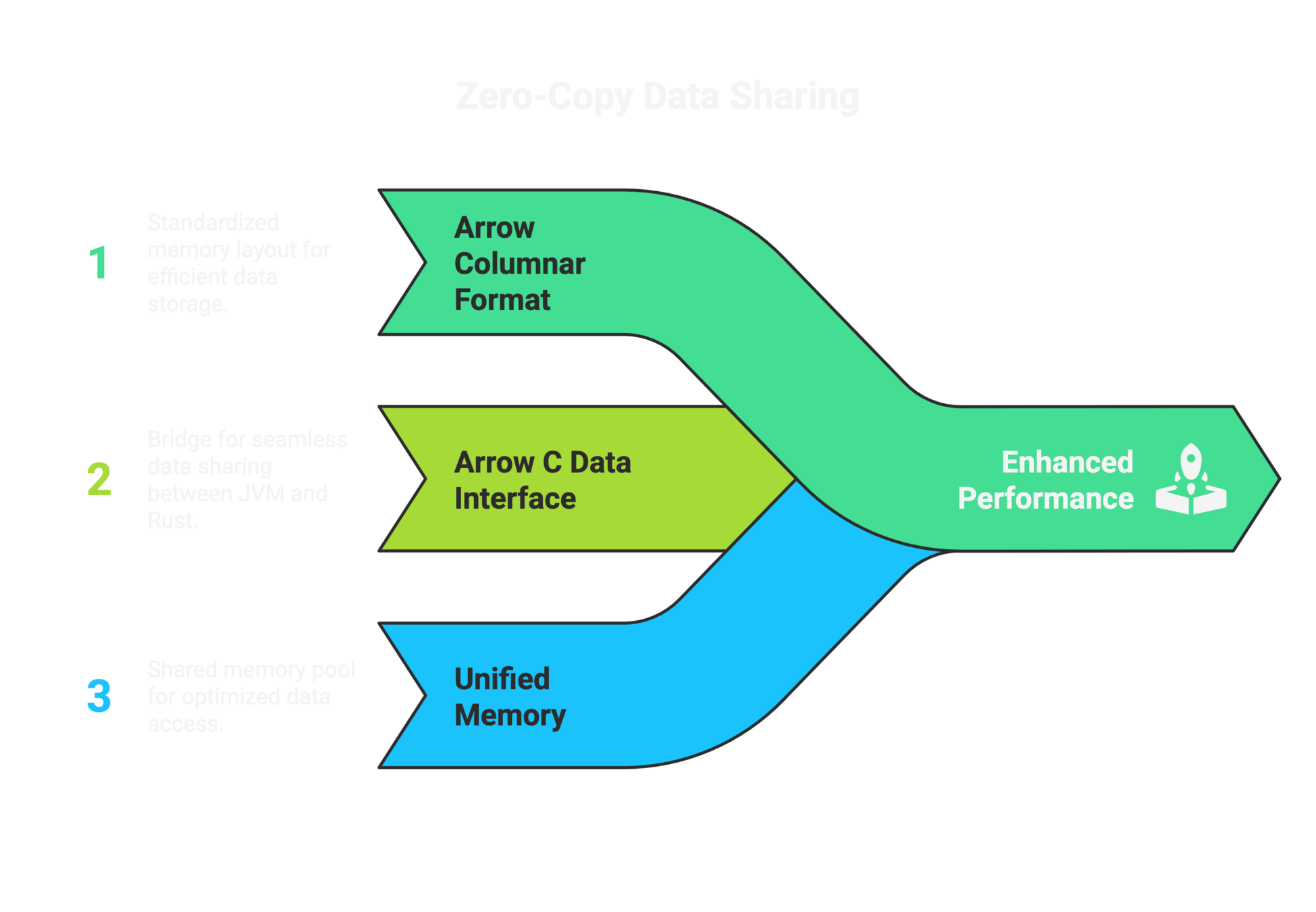
Arrow FFI lets us move compute across runtime boundaries without moving data.
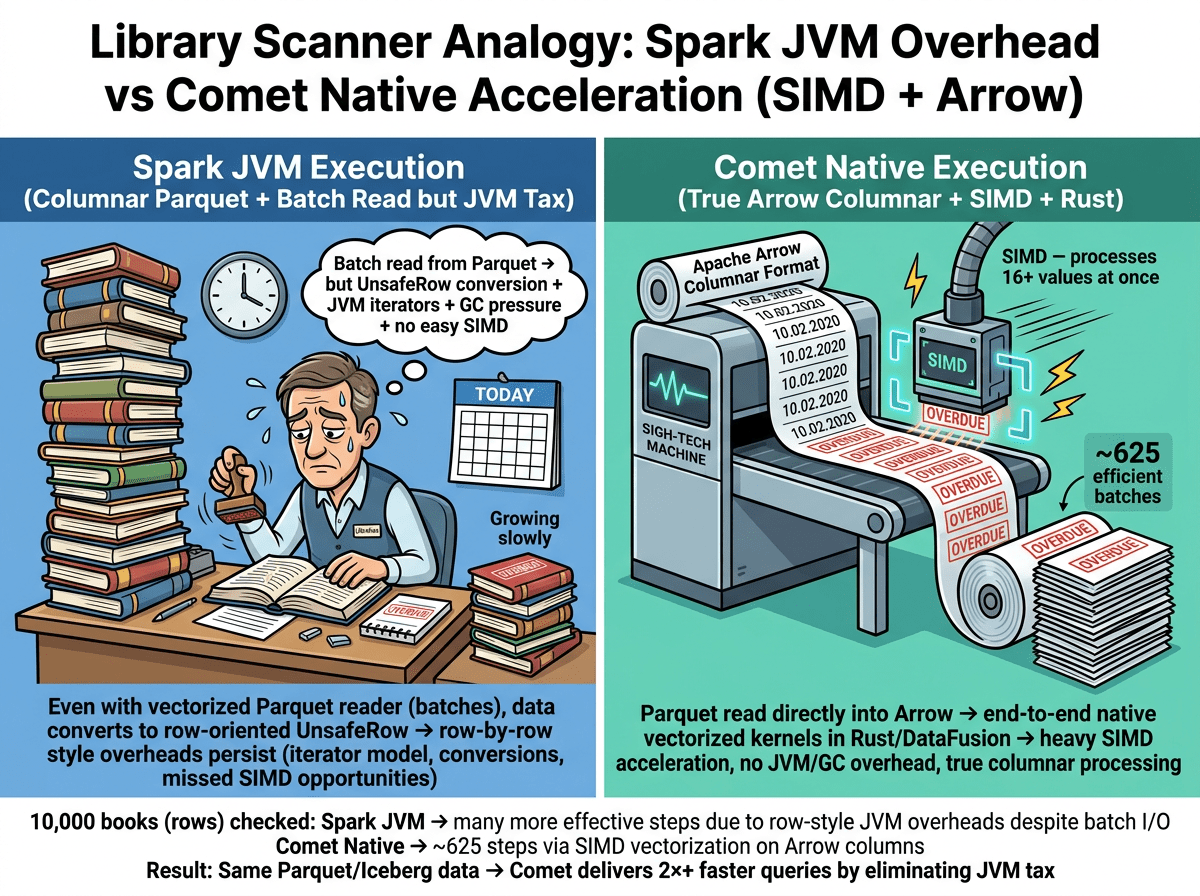
DataFusion turns a single-lane into a multi-lane
Net effect:
• Parallelism across files / row groups (I/O concurrency).
• Parallelism within a core via SIMD (many values per instruction).
Spark SQL Parser → Analyzer → Optimizer
    │ (identical to JVM flow above)
    ▼
Spark Planner
    │ produces the SAME initial physical plan:
    │   HashAggregate → Exchange → HashAggregate → Filter → BatchScanExec
    ▼

CometScanRule.apply()                          ← COMET INTERCEPTS HERE
    │ pattern-matches BatchScanExec
    │ detects SupportsComet (Iceberg scan)
    │ checks: is COMET_ICEBERG_NATIVE_ENABLED?
    │ serializes FileScanTasks → protobuf IcebergScan
    │ replaces BatchScanExec → CometIcebergNativeScanExec
    ▼

CometExecRule.apply()                          ← COMET REPLACES OPERATORS
    │ walks the physical plan bottom-up:
    │
    │   BatchScanExec           → CometIcebergNativeScanExec  (iceberg-rust: File IO, expr pushdown,
    															schema handling & evolution, MoR)
    │   FilterExec              → CometFilterExec
    │   HashAggregateExec       → CometHashAggregateExec
    │   ShuffleExchangeExec     → CometShuffleExchangeExec
    │   HashAggregateExec       → CometHashAggregateExec
    ▼

Final Physical Plan:
== Physical Plan ==
CometHashAggregate(keys=[], functions=[sum(amount)])         ← native
  └─ CometShuffleExchangeExec SinglePartition                ← native shuffle
       └─ CometHashAggregate(keys=[], functions=[partial_sum])  ← native
            └─ CometFilter [amount > 1000]                      ← native
                 └─ CometIcebergNativeScanExec [date, amount]   ← native
                      pushed: [date = '2024-01-15']
Topics to explore
-
Native Shuffle
-
Shuffle blocks (JVM) → raw bytes via JNI → native IPC decode (read_ipc_compressed) → native operator
-
-
MoR, predicate pushdown, column prunings
-
Discussions and References
-
apache/datafusion-comet:
-
Future of Iceberg Support in Comet #2921
-
Iceberg v3 Support #3376
-
Iceberg Table Maintenance: Acceleration Opportunities #3371
-
[EPIC] Iceberg Feature Matrix: Spark-Iceberg vs iceberg-rust vs datafusion-comet #3756
-
-
apache/iceberg-rust: [EPIC] Implement Missing Write Actions #2269
-

Brainstorm
What if running in GPUs / TPUs ?
~Zero shuffling in Spark execution ?
Why not by default leverage Vectorization?
JNI and Arrow FFI

Benchmark: Iceberg JVM Scan vs Native Rust Scan
Environment: macOS (Apple Silicon), Spark 3.5.8, local[*], TPC-H SF1, Iceberg tables, single iteration
export COMET_JAR=~/Documents/apache/datafusion-comet/spark/target/comet-spark-spark3.5_2.12-0.15.0-SNAPSHOT.jar
export ICEBERG_JAR=/tmp/comet-bench/jars/iceberg-spark-runtime-3.5_2.12-1.8.1.jar

SPARK_LOCAL_IP=127.0.0.1 $SPARK_HOME/bin/spark-submit \
  --master "local[*]" \
  --driver-class-path "$COMET_JAR:$ICEBERG_JAR" \
  --jars "$COMET_JAR,$ICEBERG_JAR" \
  --conf "spark.plugins=org.apache.spark.CometPlugin" \
  --conf "spark.comet.enabled=true" \
  --conf "spark.comet.exec.enabled=true" \
  --conf "spark.comet.scan.icebergNative.enabled=true" \
  --conf "spark.shuffle.manager=org.apache.spark.sql.comet.execution.shuffle.CometShuffleManager" \
  --conf "spark.sql.catalog.local=org.apache.iceberg.spark.SparkCatalog" \
  --conf "spark.sql.catalog.local.type=hadoop" \
  --conf "spark.sql.catalog.local.warehouse=/tmp/comet-bench/iceberg-warehouse" \
  --conf "spark.sql.defaultCatalog=local" \
  benchmarks/tpc/tpcbench.py \
  --benchmark tpch --catalog local --database tpch \
  --iterations 1 --output /tmp/comet-bench/results --name comet-iceberg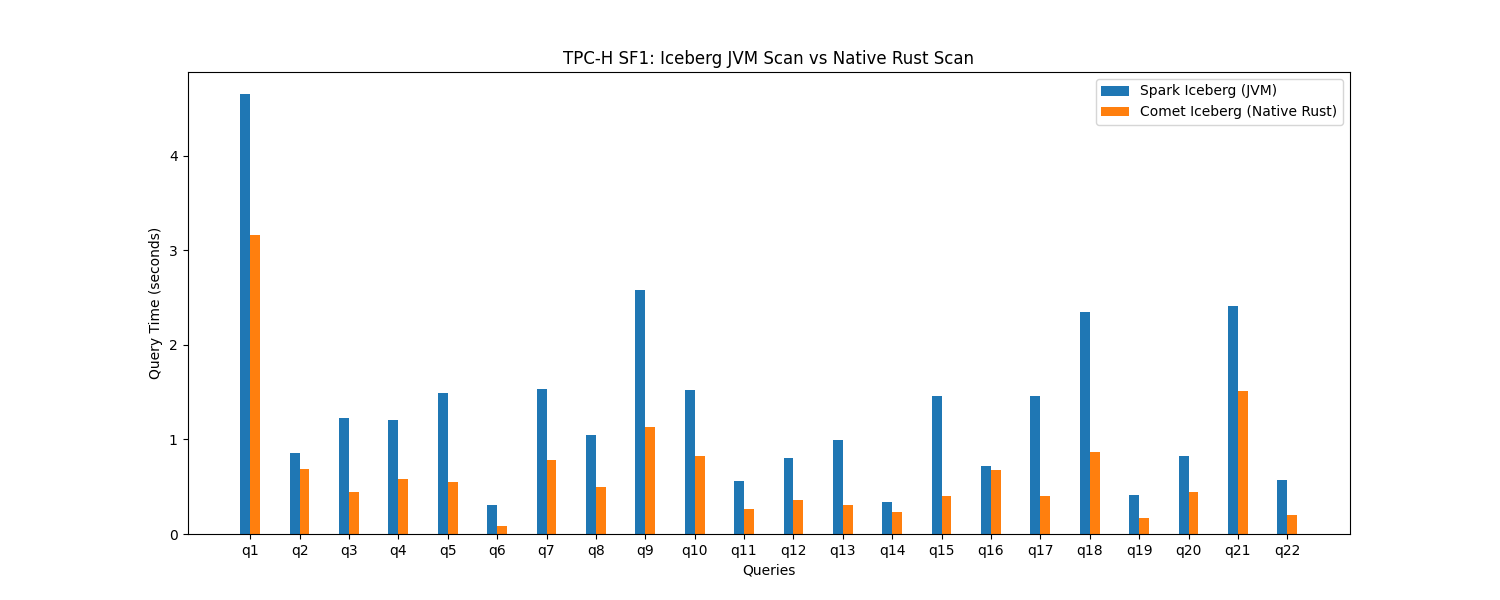
Spark JVM plan: BatchScan → Filter → Project → HashAggregate → Exchange → HashAggregate

Comet Native plan: CometIcebergNativeScan → CometFilter → CometProject → CometHashAggregate → CometExchange → CometHashAggregate
Every operator is native — scan through iceberg-rust, filter/agg/shuffle through DataFusion.
No JVM data processing in the hot path.
Benchmark: Iceberg JVM Scan vs Native Rust Scan
Why Comet wins
|
Scan + Filter (Q6) |
SIMD + vectorized Arrow scan + reduced JVM overhead → 3.6x |
|
Join‑heavy (Q5, Q9, Q18) |
Native scan + native shuffle + vectorized hash join |
|
Aggregation heavy (Q1, Q18) |
Columnar aggregation in Rust |
|
Subqueries (Q4, Q21) |
Still benefits from scan acceleration, though control‑flow limits speedup |
|
Distinct / NOT IN (Q16) |
Lower speedup (1.1x) due to set‑based operations + less scan dominance |
| Query | JVM (s) | Comet (s) | Speedup | Why it improves |
| Q4 | 4.52 | 1.74 | 2.6x | Multi‑table joins + aggregations; native scan + vectorized hash aggregation reduce JVM overhead. |
| Q11 | 3.02 | 0.79 | 3.8x | Heavy aggregations and filters; SIMD + columnar execution drive big gains. |
| Q15 | 0.38 | 0.12 | 3.2x | Small but scan‑dominated query; native scan + filter path is much faster. |
| Q19 | 0.64 | 0.16 | 4.0x | Filter‑heavy path with simple projections; best case for SIMD scan + predicate pushdown. |
TPC-DS Results
Ref: apache/datafusion-comet #3783
3 to recap
-
Spark Iceberg continues to own planning, while DataFusion Comet owns scanning and compute. This gives us mature semantics plus native performance.
-
Arrow FFI means the same columnar buffers produced by
iceberg-rustand DataFusion can be handed directly into Spark with zero copy, maintaining a single in-memory truth. -
Java implementation as the source of truth for Iceberg table semantics-snapshots, deletes, commits-while offloading the hot path (Parquet decode, row-level delete application, and columnar compute) into native Rust, where DataFusion can run SIMD-vectorized kernels and fully exploit CPU caches and hardware features.

Thank you!
Start accelerating Iceberg queries today.

What if running in GPUs / TPUs ?
~Zero shuffling in Spark execution ?
~Zero shuffling in Spark execution ?
Arrow Flight Shuffle for Comet #3596
Apache Gluten, Velox, RAPIDS
JNI call ?
Spark (JVM)                     DataFusion (Rust)
───────────                     ─────────────────
"I have a query plan"     ──►   "I'll execute it natively"
                          JNI
"Give me results"         ◄──   "Here are Arrow pointers"

Protobuf:language both sides speak to describe query plan.
FFI ?
JNI call ?
FFI (Arrow C Data Interface / Foreign Function Interface):
	Shared memory layout between languages
    Pointer to the result (zero-copy)
Default Vectorization ON
Memory model, APIs row based, JIT compiler, GC pause
Java/Spark:
  .java → javac → bytecode → JVM interprets → JIT compiles → machine code
                                                 (at runtime, after warm-up)

Rust/Comet:
  .rs → rustc → LLVM IR → LLVM optimizes → machine code → libcomet.so
                                              (at build time, with SIMD)

libcomet.so = machine code (AOT, LLVM-optimized, SIMD baked in)
.class files = bytecode (needs JVM to run, JIT compiles later)
Query JVM (s) Native Rust (s) Speedup Category
Q1 4.65 3.17 1.5x Scan + Aggregation (8 aggs on lineitem)
Q2 0.85 0.69 1.2x Multi-table join (8 tables)
Q3 1.23 0.45 2.8x Join + Sort
Q4 1.20 0.58 2.1x Correlated subquery
Q5 1.50 0.55 2.7x 6-table join + aggregation
Q6 0.31 0.09 3.6x Pure scan + filter (best SIMD case)
Q7 1.53 0.78 2.0x Multi-nation join
Q8 1.05 0.49 2.1x 8-table join
Q9 2.58 1.13 2.3x Complex join + subquery
Q10 1.52 0.82 1.9x Join + filter
Q11 0.56 0.27 2.1x Having clause
Q12 0.81 0.36 2.2x Case expressions
Q13 0.99 0.30 3.3x Left outer join + group by
Q14 0.34 0.23 1.5x Simple ratio
Q15 1.46 0.40 3.6x Temp view + max subquery
Q16 0.72 0.68 1.1x Distinct + NOT IN
Q17 1.46 0.41 3.6x Correlated subquery + avg
Q18 2.35 0.86 2.7x Large order aggregation
Q19 0.41 0.17 2.4x OR predicate
Q20 0.83 0.45 1.9x Semi-join
Q21 2.41 1.51 1.6x EXISTS + NOT EXISTS
Q22 0.57 0.20 2.9x Substring + not exists
Total 29.33 14.56 2.0x - Best speedups (3.6x): Q6 (pure scan+filter), Q15, Q17 — scan-heavy queries where SIMD vectorization dominates
- Lowest speedup (1.1x): Q16 — dominated by DISTINCT + NOT IN subquery, less scan-bound